Packed 1000 Boxes in a Day, What I Learned About Operations...
- Ajay Sapkale
- Sep 4, 2025
- 5 min read

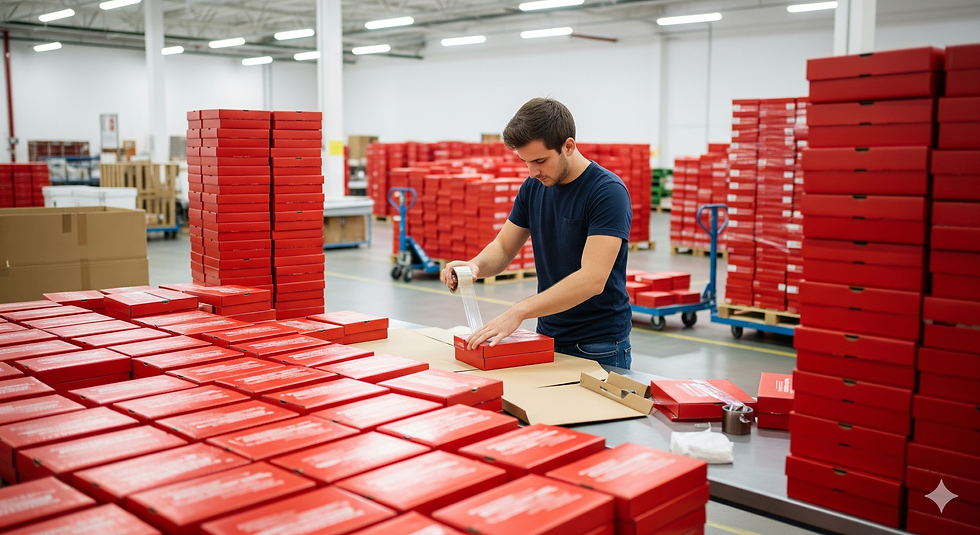
When I first started my journey as a product designer and entrepreneur, I thought the hardest challenges would revolve around design, branding, and sales. I underestimated the sheer weight of operations and logistics. That changed on the day my team and I packed 1000 boxes in a single day for an order that had to go out.
That day tested every bit of my patience, planning skills, and ability to manage people. But more importantly, it taught me timeless lessons about operations, process design, efficiency, and scaling businesses.
If you are running an e-commerce business, a D2C brand, or even managing logistics in a startup, you’ll resonate with the lessons I learned from this intense, exhausting, but transformative experience.
In this blog, I’ll take you behind the scenes of what it takes to deliver at scale, what worked, what didn’t, and the top operational strategies that made packing 1000 boxes in a day possible.
The Challenge: 1000 Boxes, One Day, Zero Room for Mistakes
The order came in as a bulk requirement. The numbers looked exciting at first — a big win for our growing brand. But the reality set in quickly:
We had to pack and dispatch 1000 boxes in a single day.
Each box contained multiple parts with specific instructions.
Packaging had to be consistent, accurate, and damage-free.
Delivery deadlines were non-negotiable.
At first, it seemed impossible. But the real challenge wasn’t just in the number. It was about creating an operation system where people, processes, and resources aligned perfectly
Lesson 1: Operations is About System, Not Just Hard Work
Many founders believe that sheer effort and long hours will solve operational challenges. The truth? Hard work without systems only creates chaos.
We learned quickly that to get through 1000 boxes in a day, we needed:
Clear workflow mapping — from material sourcing to final sealing.
Defined roles — who does what, and in what sequence.
Error-proofing systems — checks at every stage to avoid costly mistakes.
This was my first real experience with lean operations. Once you have a system, the outcome feels almost automatic. Without one, the harder you work, the more mess you create.
Lesson 2: The Power of the Assembly Line
When Henry Ford created the assembly line, he wasn’t just making cars faster. He was reinventing how teams produce at scale.
We adopted the same principle:
One team member prepared the packaging materials.
Another team arranged parts by sequence.
Others handled boxing, labeling, and sealing.
Finally, a quality check team verified each box.
Instead of one person packing an entire box from start to finish, the assembly-line method allowed us to increase speed while reducing errors.
This system alone cut our packing time by nearly 40%.
Lesson 3: Time Management is Inventory Management
The clock was our biggest enemy. Every hour lost meant higher risk of missing the deadline.
We broke the day into time blocks:
First 2 hours: Material prep.
Next 6 hours: Assembly-line packing.
Final 2 hours: Quality checks and dispatch prep.
By treating time as inventory, we could allocate resources more wisely.
This is a principle every operations manager should internalize: time is a resource that can be allocated, wasted, or optimized.
Lesson 4: People Are the Core of Operations
No matter how great the system, it’s the people that execute it. Managing a team of packers, helpers, and coordinators taught me some valuable lessons:
Clear instructions beat assumptions. Never assume someone knows what to do.
Morale impacts productivity. We played music, ordered food, and kept spirits high.
Fatigue creates errors. Breaks are non-negotiable.
When people feel respected and motivated, their efficiency naturally improves.
Lesson 5: The Role of Tools and Infrastructure
We underestimated the importance of simple tools like:
Tape dispensers (instead of cutting tape manually).
Pre-printed labels (to avoid handwriting errors).
Box organizers (to keep parts in sequence).
Small tools made a huge difference in speed and accuracy.
This aligns with a key operations insight: invest in the right infrastructure early, and it will save you hours later.
Lesson 6: Quality Control Cannot Be Skipped
In the rush to meet deadlines, it’s tempting to skip quality checks. But a single mistake in even 5% of 1000 boxes means 50 unhappy customers.
We introduced a 2-step quality process:
Internal check by the packer.
External check at the end.
The double-checking slowed us slightly, but it saved us from returns, complaints, and brand damage.
Lesson 7: Communication is the Lifeline
The day we packed 1000 boxes, communication was constant:
Who needed what?
Where were the bottlenecks?
How far were we from targets?
We used a simple whiteboard system to track progress and assign responsibilities. Every time a milestone was achieved, it was marked off.
This created clarity, reduced confusion, and gave everyone a sense of achievement.
Lesson 8: Operations is About Scalability
The biggest takeaway? If we could scale to 1000 boxes in a day once, we could do it again.
But the only reason it worked was because we had built repeatable systems.
This is the essence of scalable operations:
Can your process handle 10x growth without breaking?
Can new people plug into the system without hours of training?
By the end, we had a playbook for scaling that we could replicate for future orders.
Bonus Lessons
Documentation matters: We documented every step for future reference.
Suppliers are part of operations: Timely delivery of materials made everything smoother.
Celebrate the win: At the end of the day, we treated ourselves. A motivated team is the best long-term asset.
Key Takeaways for Entrepreneurs and Startups
Don’t rely on hustle alone — build systems.
Adopt assembly lines for faster, error-free output.
Manage time like inventory — allocate it wisely.
Take care of your people — productivity follows morale.
Invest in tools that simplify repetitive tasks.
Never skip quality checks, no matter the rush.
Communicate constantly to avoid chaos.
Document and replicate for scalable growth.
Final Thoughts
Packing 1000 boxes in a day wasn’t just about getting an order out. It was a crash course in operations, management, and scalability.
For entrepreneurs, founders, and business owners, the lesson is clear: operations isn’t the back-end, it’s the backbone of your business.
Whether you’re running a small e-commerce store, a design studio, or a manufacturing unit, your ability to design systems will define your ability to scale, deliver, and retain trust.
And sometimes, the best MBA in operations comes not from a classroom — but from a warehouse filled with 1000 boxes waiting to be shipped.
~designed by ajaysapkale



Comments